If you are choosing between Shopify Basic and Grow, the bigger question is not the plan label. It is whether you already need staff accounts, live third-party carrier rates at checkout, or lower transaction fees badly enough to pay more for Grow.
The short answer
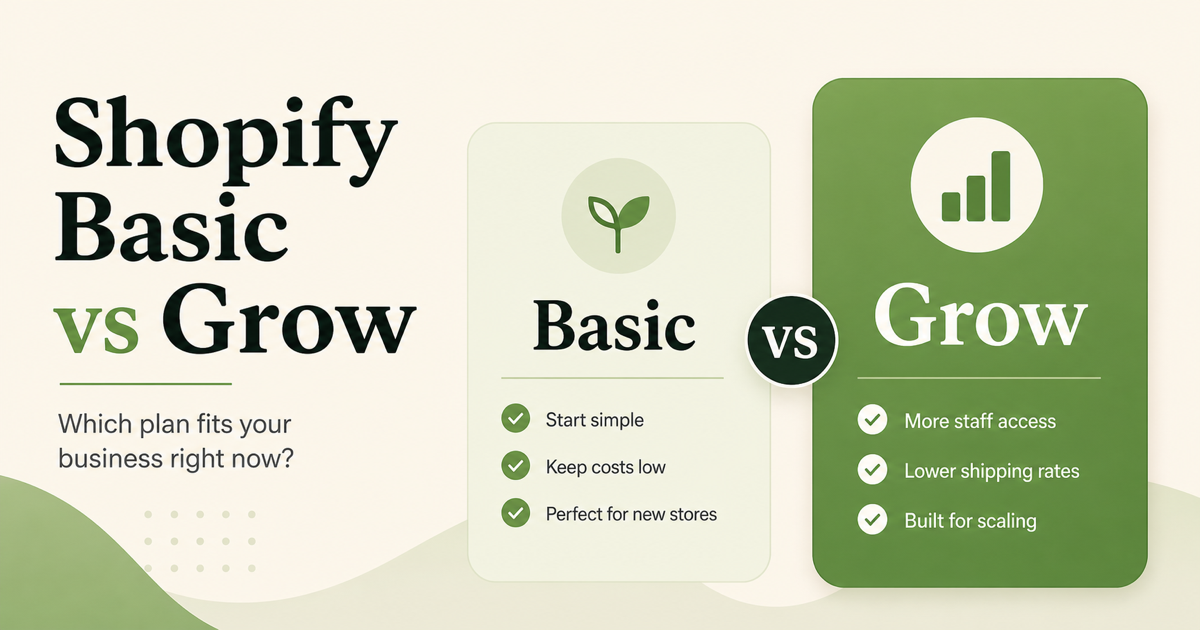
- Choose Basic if you are still running one store on your own and you do not need staff accounts, third-party carrier-calculated shipping, or lower payment fees badly enough to justify the higher plan cost.
- Choose Grow when more than one person needs admin access, live third-party carrier rates need to show at checkout, or lower payment fees can offset the higher annual-billed plan cost.
Current price gap
Because Shopify local pricing and promotions can vary, this article does not hard-code the exact Basic versus Grow dollar gap.
The practical decision still does not change: Grow costs more than Basic, annual billing is paid upfront for the full year, and the fee break-even logic below matters only after you compare the current annual-billed totals in Shopify’s plan table.
Side-by-side view
| Area | Basic | Grow |
|---|---|---|
| Annual billed price | Lower than Grow | Higher than Basic |
| Best for | Solo owner or first store | Small team needing separate access or lower fees |
| Staff accounts | No extra staff accounts | Up to 5 user accounts |
| Reports and data explorations | Included | Included |
| Shopify Payments card rates | Higher than Grow | Lower than Basic |
| Third-party payment provider fee | 2% | 1% |
| Third-party carrier-calculated shipping | Not available | Included with annual billing |
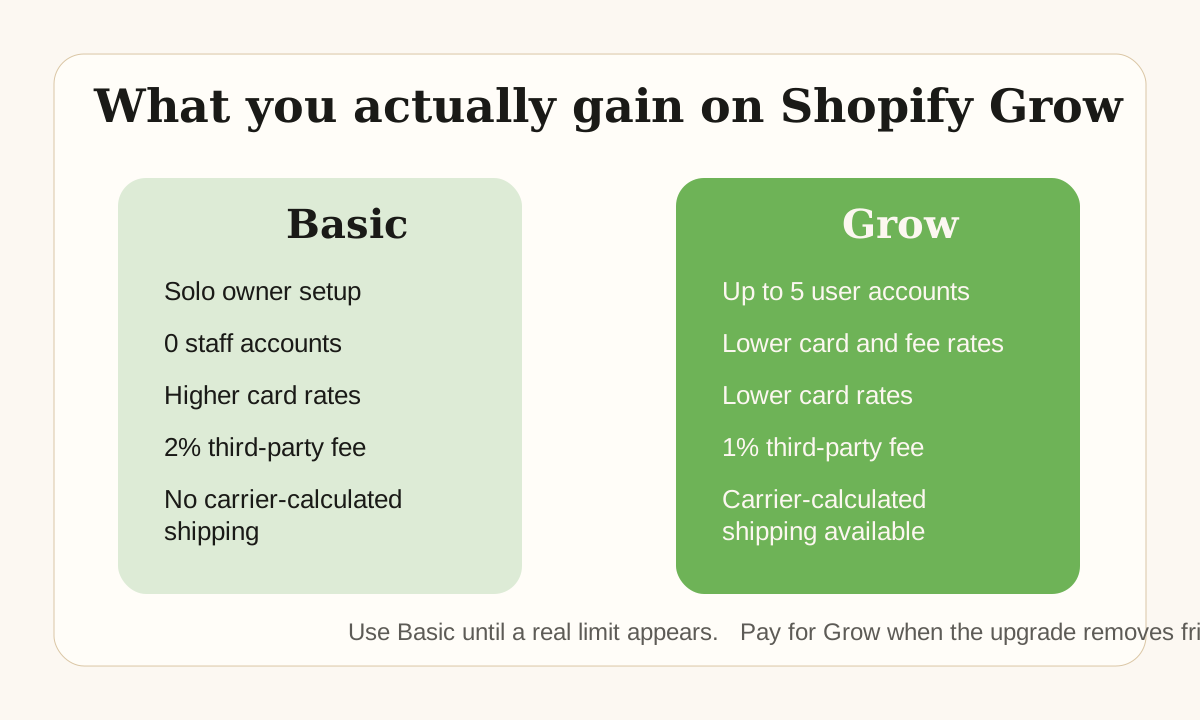
What actually changes when you upgrade
1. Upgrade when more than one operator needs admin access
Basic does not support adding staff accounts. Grow supports up to five user accounts.
If one person still runs the store, that difference may not matter yet. If people who handle operations, support, or fulfillment need separate logins, Basic stops being workable.
2. Reporting is no longer the cleanest reason to upgrade
All plans already include the analytics page and finance reports. Current Shopify docs also list custom reports and data explorations on Basic.
That means reporting is no longer the clearest dividing line between Basic and Grow. If reporting is your only reason to upgrade, re-check the current Basic plan features before you pay more.
3. Upgrade if you need live carrier rates at checkout
Shopify says third-party carrier-calculated shipping is unavailable on Basic. To activate it, you need Grow, Advanced, or Plus. On Grow, Shopify says it is either added as a paid option or included with annual billing.
If your shipping setup already depends on live third-party carrier rates at checkout, that is a stronger reason to upgrade than order volume alone.
4. Payment fee savings can justify Grow
Grow lowers both Shopify Payments rates and third-party transaction fees.
That third-party fee difference mainly matters when you use a third-party payment provider. Shopify also lists store credit and gift card exceptions for some stores. For standard card orders processed through Shopify Payments, Shopify says third-party transaction fees do not apply.
Shopify’s help center publishes a break-even estimate, not a store-specific calculator. In Shopify’s help-center guidance for the US, UK, and Ireland, the Grow break-even point is about $200,000 a year if you use Shopify Payments, or about $60,000 a year if you do not use Shopify Payments.
If you use Shopify Payments and you are well below Shopify’s own break-even estimate, fees alone probably do not justify Grow. If lower payment fees are the main reason to upgrade and you use a third-party payment provider, the move becomes easier to justify as you get closer to Shopify’s $60,000 estimate.
When Grow actually pays off
Basic is enough while one owner can still run the store, live third-party carrier rates are not part of the workflow, and payment-fee savings are too small to cover the higher annual-billed plan cost.
Grow pays off when you need staff accounts, carrier-calculated shipping, or enough fee savings to cover the higher plan cost. It is an upgrade for current operating friction, not a reward for rising sales.
If you are still deciding on the platform itself rather than the plan, read our Shopify vs WooCommerce pricing comparison.